- 您现在的位置:买卖IC网 > Sheet目录1062 > 101-0506 (Rabbit Semiconductor)CARD CPU SR9160 128K SRAM SMRTST
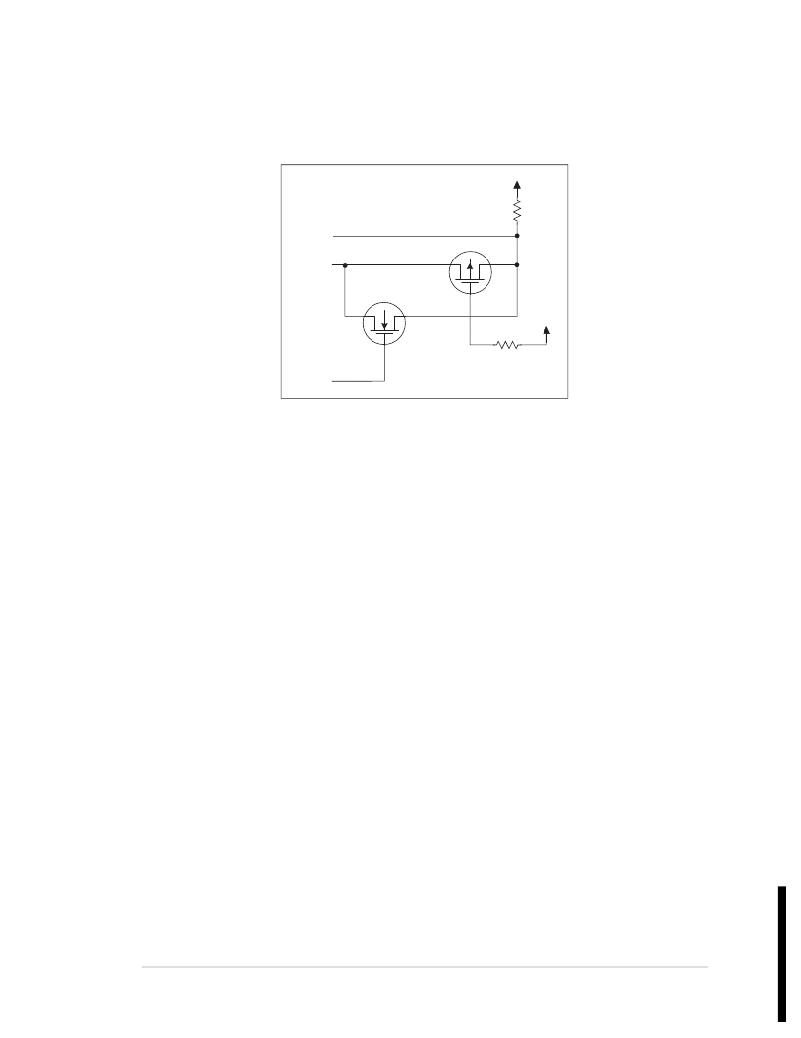
C.3 Chip Select Circuit
VRAM
R31
/CSRAM
Q4
/CS1
Q5
VRAM
R37
10 k W
/RES
Figure C-5. Chip Select Circuit
The current drain on the battery in a battery-backed circuit must be kept to a minimum.
When the CPU Card is not powered, the battery keeps the SRAM memory contents and
the real-time clock (RTC) going. The SRAM has a powerdown mode that greatly reduces
power consumption. This powerdown mode is activated by raising the chip select (CS)
signal line. Normally the SRAM requires +5 V to operate. However, only 2 V is required
for data retention in powerdown mode. Thus, when power is removed from the circuit, the
battery voltage needs to be provided to both the SRAM power pin and to the CS signal
line. The CS control circuit accomplishes this task for the CS signal line.
In a powered-up condition, the CS control circuit must allow the processor ’s chip select
signal /CS1 to control the SRAM’s CS signal /CSRAM. So, with power applied, /CSRAM
must be the same signal as /CS1, and with power removed, /CSRAM must be held high
(but only needs to be battery voltage high). Q4 and Q5 are MOSFET transistors with
opposing polarity. They are both turned on when power is applied to the circuit. They
allow the CS signal to pass from the processor to the SRAM so that the processor can peri-
odically access the SRAM. When power is removed from the circuit, the transistors will
turn off and isolate /CSRAM from the processor. The isolated /CSRAM line has a 100 k ?
pullup resistor to VRAM (R31). This pullup resistor keeps /CSRAM at the VRAM voltage
level (which under no power condition is the backup battery’s regulated voltage at a little
more than 2 V).
Transistors Q4 and Q5 are of opposite polarity so that a rail-to-rail voltage can be passed.
When the /CS1 voltage is low, Q5 will conduct. When the /CS1 voltage is high, Q4 will
conduct. It takes time for the transistors to turn on, creating a propagation delay. This
delay is typically very small, about 10 ns to 15 ns.
The signal that turns the transistors on is a high on the processor ’s reset line, /RES. When
the CPU Card is not in reset, the reset line will be high, turning on n-channel Q5. When a
reset occurs, the /RES line will go low.
User ’s Manual
171
发布紧急采购,3分钟左右您将得到回复。
相关PDF资料
101-0545
PROTOTYPING BOARD FOR LP3500
101-0563
RCM3400 PROTO BOARD
101-0589
CLONING BOARD RABBIT
101-0688
CARD D/A EXPANSION RN1300
101-0954
KIT DEV RABBIT RCM3360/3370 INTL
101-1050-BE-00025
ADPT USB 2 A FEMALE-2 5PIN .25M
10112627-101LF
MINI-SAS HD 1X2 EXT PCB
10112628-101LF
MINI-SAS HD 1X4 EXT PCB
相关代理商/技术参数
101-0507
功能描述:模块化系统 - SOM RCM3000 RABBITCORE
RoHS:否 制造商:Digi International 外观尺寸:ConnectCore 9P 处理器类型:ARM926EJ-S 频率:150 MHz 存储容量:8 MB, 16 MB 存储类型:NOR Flash, SDRAM 接口类型:I2C, SPI, UART 工作电源电压:3.3 V 最大工作温度:+ 85 C 尺寸:1.97 in x 1.97 in x 6.1 in
101-0508
功能描述:模块化系统 - SOM RCM3010 RABBITCORE
RoHS:否 制造商:Digi International 外观尺寸:ConnectCore 9P 处理器类型:ARM926EJ-S 频率:150 MHz 存储容量:8 MB, 16 MB 存储类型:NOR Flash, SDRAM 接口类型:I2C, SPI, UART 工作电源电压:3.3 V 最大工作温度:+ 85 C 尺寸:1.97 in x 1.97 in x 6.1 in
101050-9
制造商:RUKO 功能描述:Bulk 制造商:RUKO 功能描述:STEP DRILL 4-12MMX1MM 制造商:RUKO 功能描述:STEP DRILL, 4-12MMX1MM 制造商:RUKO 功能描述:STEP DRILL, 4-12MMX1MM; Drill Bit Size Metric:4mm; Overall Length:65mm; SVHC:No SVHC (19-Dec-2012); Drill Bit Type:Step; Drill Point Diameter:4mm; Material:HSS; Range:4mm - 12mm; Shank Dia:6mm; Step:1mm ;RoHS Compliant: NA
101050BO
制造商:TE Connectivity 功能描述:
101051
制造商:RUKO 功能描述:STEP DRILL 4-20MMX2MM 制造商:RUKO 功能描述:STEP DRILL, 4-20MMX2MM 制造商:RUKO 功能描述:STEP DRILL, 4-20MMX2MM; Drill Bit Size Metric:4mm; Overall Length:75mm; SVHC:No SVHC (19-Dec-2012); Drill Bit Type:Step; Drill Point Diameter:4mm; Material:HSS; Range:4mm - 20mm; Shank Dia:8mm; Step:2mm ;RoHS Compliant: NA
10-105108-03G
制造商:Amphenol Aerospace 功能描述:10-105108-03G
10-105108-03P
制造商:Amphenol Aerospace 功能描述:10-105108-03P
10-105108-04P
制造商:Amphenol Aerospace 功能描述:10-105108-04P